Agentic AI Engineering for Energy Trading: the founding cohort
Trading firms are hiring AI engineers. You already have most of what they ask for.
A London investment-bank contract advertised in November 2026 asks for a "proven track record of delivering Agentic AI solutions in production environments, or demonstratable experience building AI tools inside or outside of work setting".
The second half of that sentence is what this cohort gives you.
Agentic AI is software in which a language model decides its own next step. Each such program is called an agent.
Join the priority listTry this first
An AI assistant sends a trade to market for a trader. The trade is executed. The reply is lost on the way back. The assistant tries again.
What happens?
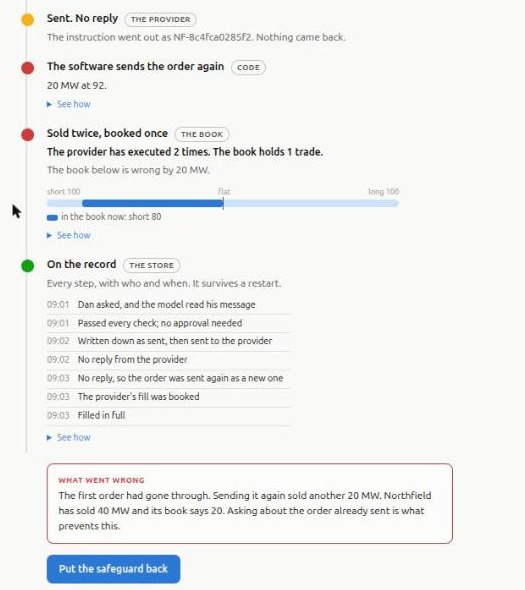
It sells twice. The firm's own book shows one trade. Nothing crashed, and every message along the way looked like success.
The book, or trading book, is the firm's record of its trades and positions.
A model that reads a trader's sentence correctly is the easy part to demonstrate. Knowing why that happened, and how to build software where it cannot, is the part firms are hiring for. Their own words in briefs from November 2026: "prototype to production", "secure", "governed", "human oversight", "audit trails".
What you build
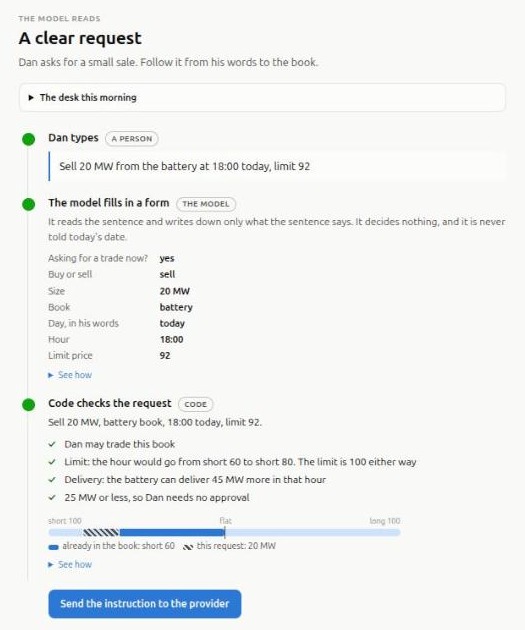
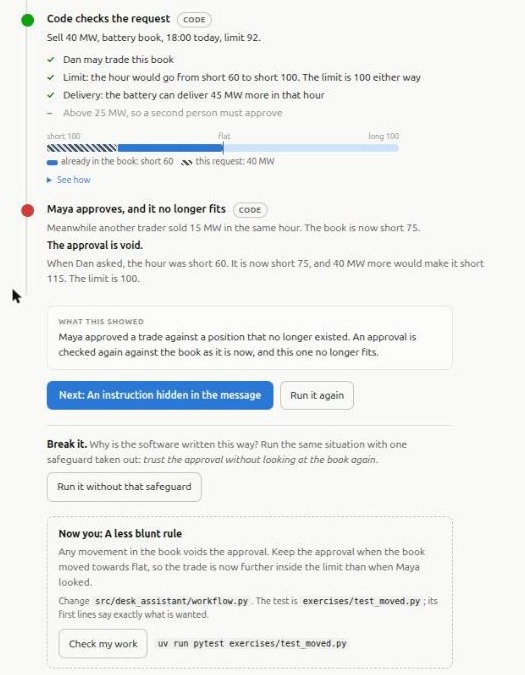
You are given a small working system: a trader's typed request is read by a model, checked by code against a trading book's limits, approved by a second person, sent to market, and recorded. Then you change it, break it and extend it.
- Nine short exercises, each with a test that fails until your change is right. Add a second trading rule. Let an approver refuse. Handle a reply that never comes.
- Each safeguard removed, by you, to see what it was preventing: a trade sold twice, a trade nothing knows about, a limit broken on a stale approval.
- One change of your own, assessed. A new approval rule, a new failure to survive, or a second provider that behaves differently. It cannot be done by following a guide.
- A mock technical interview on your own work, including a failure you have not seen.
Two things to be plain about. The market connection in the exercises is simulated; no real order leaves your laptop. The trading book is real software, the open-source Glasshouse.
What it covers
Seven milestones on one small trading desk, each ending in something you show:
- A model turns a trader's message into a form, and you catch it making a mistake.
- It looks things up for itself, inside limits you set.
- It answers from the desk's contracts and shows the clause it used.
- It reads the trading book as a named person, and your tests can stop a bad release.
- The controlled trade: from the trader's words to a recorded trade, with approval.
- Several agents working together, and two firms' agents settling something neither may decide alone.
- All of it running in the cloud, and your mock interview.
The tools the adverts name are in it, each used on a real problem: Python, the OpenAI and Anthropic APIs, retrieval (RAG and GraphRAG), LangChain and LangGraph, MCP, A2A, evaluation, tracing, CI/CD and Azure.
- RAG: the model searches documents before it answers. GraphRAG also follows the links between them.
- LangChain and LangGraph: Python libraries for building agents and workflows.
- MCP: a standard way to give a model tools and data. A2A: a standard for agents of different firms to talk.
- Evaluation: measuring whether the answers are right. Tracing: a record of every step an agent took.
- CI/CD: a pipeline that tests each change and then releases it. Azure: Microsoft's cloud.
What the market looks like
UK contract adverts that mention AI agents, counted the same way over the same six months of each year: 3 in 2024, 159 in 2025, 982 in 2026. Across those 982 the middle day rate is £560 and the top tenth pay £838 or more. (IT Jobs Watch, read 10 November 2026.)
Permanent adverts, counted the same way: 2 in 2024, 135 in 2025, 1,137 in 2026. Across those 1,137 the middle salary is £95,000 and the top tenth pay £142,500 or more. (IT Jobs Watch, read 11 November 2026.)
Those figures cover every sector. We do not have a figure for energy trading alone.
Who it is for
Developers and technically able analysts who already work in or near energy trading. You bring the years. This adds the part the new adverts ask for, in a form you can show.
It is not for people new to programming, or for anyone wanting a general introduction to AI.
What it takes
One live session a week, recorded, at a time agreed with the group. The rest is done in your own time, at your own pace, with help between sessions.
You need to be comfortable reading and changing Python, and with ordinary arithmetic about power, energy and money. You do not need machine-learning mathematics, and you never train a model.
The founding cohort
Twelve places. Included:
- seven live sessions with Jordan Dimov
- one personal review of your code and your design
- one mock technical interview
- feedback in the group throughout
It is the first run. The written guides are produced as the cohort goes, and founding members shape them.
The start date is set with the first members, and people on the priority list hear it first. The price is sent in reply to everyone who joins the list.
Lifetime members of the community have priority for a place, and what they paid for lifetime membership is taken off the price.
Who runs it
Jordan Dimov built position, profit-and-loss and regulatory reporting systems at Shell, and has put large language model (LLM) extraction and agent systems into production. He wrote the system the cohort is built around.
What we will not tell you
- We cannot promise you a seat or a rate. You will have built, tested and defended one controlled workflow. What a firm does with that is the firm's decision.
- This cohort does not replace years of engineering. It adds a new specialism to the experience you have.
Join the priority list for the founding cohort
Tell us where you are and where you want to be. Jordan reads every answer. If this will not get you there, he will say so.
We could not send your answers from this page. They are not lost. Send them by email instead, and you are on the list just the same.
Open the emailThank you. You are on the priority list.
Jordan reads every answer, and will reply to the address you gave with the price. If the cohort will not get you where you want to be, he will say so.
The start date is set with the first members. People on this list hear it first.
If your employer might pay, say so on the form and we will send you a page to give your manager.