Physical gas trading is the buying and selling of gas that is really delivered. In Great Britain almost all of it changes hands at one virtual point, the National Balancing Point (NBP). Companies buy and sell there months ahead, the day before and during the day itself. National Gas, which runs the high-pressure pipeline network, keeps the system in balance. After each day, every company pays or is paid for the gap between the gas it put in and the gas it took out.
This article follows one supplier through one gas day, with one set of numbers. It is written for engineers, analysts and anyone joining a gas or power desk for the first time. For how physical trades differ from swaps and futures, see physical and financial energy trading. For where Britain's gas comes from in the first place, see the global gas market.
Why gas is traded differently from power
Electricity has to be made in the instant it is used. Gas does not. The pipes themselves hold gas under pressure, and the amount they hold is called the linepack. When demand jumps, pressure falls a little and the pipes cover the gap for a few hours. The physical foundations article explains this buffer.
That buffer changes how the market works. Power is settled half-hour by half-hour, 48 times a day. Gas is settled once a day. A company only has to put in as much gas as its customers take out over the whole gas day. A shortfall in the morning can be made up in the afternoon.
Our example is a small supplier with about 40,000 homes as customers. It is also a shipper: a company licensed to put gas into the network and take it out. (A supplier sells to homes and bills them. A shipper moves gas wholesale. Many companies are both.) We follow one gas day in January, which starts on a Wednesday morning.
The NBP and its units
The NBP is not a place. You cannot visit it. It stands for the whole National Transmission System, the high-pressure pipes that run across England, Scotland and Wales. Gas inside that system is treated as being in one spot. So a trade at the NBP is a change of owner, not a journey down a particular pipe.
That makes trading simple. A power station in Kent and a gas network in Aberdeen buy the same product at the same price. Moving the gas from where it enters to where it leaves is National Gas's job, not the trader's.
British gas prices are quoted in pence per therm, an old British unit. One therm is 29.3071 kilowatt-hours (kWh). Two conversions come up all the time:
- p/therm to £/MWh: multiply by 0.3412. So 85 p/therm is £29.00 per megawatt-hour (MWh).
- Therms to energy: 100,000 therms is about 2.93 million kWh, or 2,931 MWh.
The European benchmark, TTF in the Netherlands, is quoted in euros per MWh. Comparing the two needs both the unit conversion and the exchange rate.
The gas day
The British gas day runs from 05:00 to 05:00, UK clock time. The day of 14 January starts at 05:00 on the 14th and ends at 05:00 on the 15th. The time follows British Summer Time, so the day in late October has 25 hours and the one in late March has 23.
It has started at 05:00 since 1 October 2015. Before that it began at 06:00. The change lined Britain up with the gas day on the Continent, which runs from 06:00 to 06:00 Central European Time. In both seasons, 05:00 in London and 06:00 in Amsterdam are the same moment.
The power market uses midnight to midnight. So gas delivered on "Wednesday" overlaps two power days. We come back to this below.
The stages at a glance
| Stage | When | What it is for | How the price is set |
|---|---|---|---|
| Forward trading | Months to days ahead | Buying most of the gas early | Each trade has its own price |
| Day-ahead trading | The day before | Topping up to the latest forecast | Each trade has its own price; indices sum up the day |
| Nominations | The day before, revised on the day | Telling National Gas what will flow | No price |
| Within-day trading on the OCM | Until 02:35 at the end of the gas day | Fixing the position as the day unfolds; National Gas balances the system | Each trade has its own price; their average is the System Average Price |
| Cash-out | After the gas day | Settling each shipper's daily imbalance | System Marginal Buy or Sell Price |
| Reconciliation | Months later | Correcting estimated demand with real meter readings | The day's prices, applied to the corrections |
Forward and day-ahead trading
Most British gas is bought well before the day it is used. Desks trade in standard blocks of time: a year, a season, a quarter, a month, a weekend, a single day. Summer is April to September and winter is October to March.
There are two ways to trade:
- On an exchange. ICE Futures Europe lists NBP futures, from single days out to years ahead. A contract is 1,000 therms a day for every day of its period. The exchange's clearing house stands between buyer and seller, so neither has to trust the other.
- Over the counter (OTC). Two companies agree a deal directly, usually through a broker who finds the other side. OTC deals can be any shape: more gas on weekdays, a non-standard period, an unusual price formula.
Ofgem counts the volumes. In the third quarter of 2026, 71% of British gas volume traded on exchanges. The rest went through OTC brokers. That count leaves out deals agreed without a broker. The same gas also changes hands many times before it is used. Ofgem's churn ratio for the quarter was 16.0.
The day-ahead market is the busiest short-term market. Price reporters such as Argus and ICIS assess a day-ahead price at around 16:30 each working day. Many contracts settle against those published numbers.
The supplier's month. In December it bought 80,000 therms a day for all of January, as a forward, at 85 p/therm. That covers a normal winter day for its customers. For one day it costs 80,000 x 85p = £68,000.
The supplier's Tuesday. The forecast for Wednesday's gas day is colder than normal: 100,000 therms. The supplier buys the missing 20,000 therms day-ahead through a broker, at 90 p/therm. That costs 20,000 x 90p = £18,000.
Nominations: telling National Gas what will flow
Buying gas at the NBP gives a shipper the right to gas inside the system. It does not move any gas. For that, shippers tell National Gas what will flow at each point where gas enters or leaves the system. These notices are nominations.
Who nominates what depends on the customer:
- Big customers such as power stations and factories have meters read every day. Their shipper nominates for them.
- Homes and small businesses are not metered daily. For these, National Gas makes the nomination itself, on the shipper's behalf, from its own demand forecast. It updates that forecast through the day.
- Every NBP trade off the OCM is reported by both sides as a trade nomination. The two notices must match, and they can be sent until 03:00 at the end of the gas day. For OCM trades, the market's operator sends them.
| Time | What happens |
|---|---|
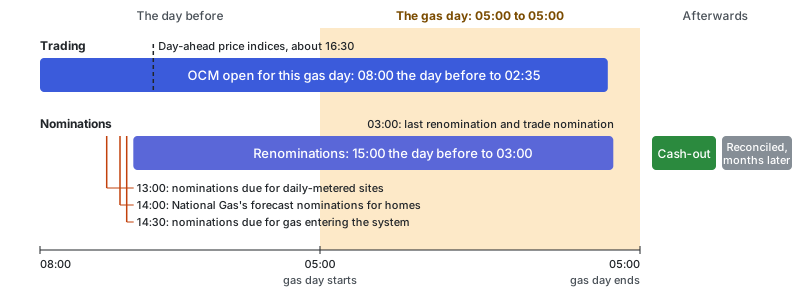
| 08:00, the day before | The OCM opens for this gas day |
| 13:00, the day before | Nominations due for daily-metered customers |
| 14:00, the day before | National Gas sends each shipper its nominations for homes and small businesses |
| 14:30, the day before | Nominations due for gas entering the system at the terminals |
| 15:00, the day before | Renominations (revisions) open |
| 05:00 | The gas day starts |
| 02:35, at the end of the day | The OCM closes |
| 03:00, at the end of the day | Last renomination; last trade nomination |
| 05:00 | The gas day ends |
From the Uniform Network Code, the rules every shipper signs up to (Transportation Principal Document, Section C), and ICE's OCM specification. The one-hour lead time on revisions and the even-flow rule are in the same section. Checked 16 November 2026. The interconnector points at Bacton follow the European timetable instead: entry nominations by 13:00 the day before, a two-hour lead time on each revision, and the last revision at 02:00.
A revision takes effect at least an hour after it is sent. The system also assumes gas flows at an even rate across the day. So by 17:00, half of the day's nomination is treated as already delivered. A shipper cannot revise its total below what has already flowed.
The supplier's nominations. Its customers are all homes, so National Gas nominates their demand for it: 100,000 therms on Tuesday afternoon. The supplier and its broker counterparty each send a trade nomination for the 20,000 therms bought day-ahead. The supplier's December forward is reported the same way.
Within-day trading on the OCM
Once the gas day is under way, forecasts keep changing. Companies fix their positions on the On-the-day Commodity Market (OCM), a screen market for gas on the current day. ICE Endex runs it for National Gas. Buyers and sellers are anonymous, and every trade has its own price.
National Gas trades there too, as the residual balancer. It does not trade for profit. If shippers together have left the system short, it buys gas; if they have left it long, it sells. It does this only for what the shippers have not fixed themselves. National Gas says it has historically traded on around 50 to 70% of gas days.
The supplier's Wednesday. By 09:00 it is colder still, and National Gas's forecast for the supplier's homes rises to 106,000 therms. The supplier buys 5,000 therms on the OCM at 95 p/therm, for 5,000 x 95p = £4,750. The supplier sends no trade nomination for it: the OCM's operator sends them for both sides.
Cash-out: the System Average and Marginal Prices
After the gas day, each shipper's position is added up. Its daily imbalance is the gas it put in or bought, minus the gas its customers took out or it sold. A shipper that is long sells the surplus to National Gas. A shipper that is short buys the shortfall from National Gas. This is cash-out, and it uses three prices.
- System Average Price (SAP): the average price of all OCM trades for the gas day, weighted by volume.
- System Marginal Buy Price (SMP Buy): SAP plus a fixed margin, or the most National Gas itself paid on the OCM that day, whichever is higher. A short shipper pays this.
- System Marginal Sell Price (SMP Sell): SAP minus the same margin, or the least National Gas itself sold for on the OCM that day, whichever is lower. A long shipper is paid this.
The fixed margin is the Default System Marginal Price. From 1 October 2026 it is 0.0771 pence per kWh, or about 2.26 p/therm. Cash-out prices are set in pence per kWh; this article converts them to p/therm so that all its prices are in one unit.
The design is deliberate. A short shipper always pays more than the day's average, and a long one always receives less. Fixing a position on the OCM is usually cheaper than leaving it to National Gas.
The supplier's bill. Homes are not metered daily, so their demand is worked out by formula from the day's actual weather. The supplier's customers come out at 108,000 therms. It had bought 105,000, so it was 3,000 therms short.
That day, SAP was 94 p/therm. SAP plus the margin is 96.26 p/therm. But the system ran short in the evening, and National Gas's most expensive OCM buy was at 99 p/therm. The higher of the two sets SMP Buy at 99 p/therm. The supplier pays 3,000 x 99p = £2,970.
Had the supplier been long by 3,000 therms instead, it would have been paid SMP Sell. National Gas sold no gas that day, so SMP Sell is SAP minus the margin: 91.74 p/therm.
The whole example
| Stage | Volume | Price | Cost |
|---|---|---|---|
| Forward, bought in December | 80,000 therms | 85 p/therm | £68,000 |
| Day-ahead, Tuesday | 20,000 therms | 90 p/therm | £18,000 |
| OCM, Wednesday morning | 5,000 therms | 95 p/therm | £4,750 |
| Cash-out, short | 3,000 therms | 99 p/therm | £2,970 |
| Total | 108,000 therms | 86.78 p/therm on average | £93,720 |
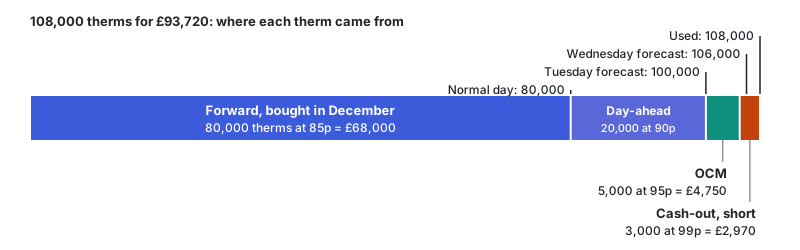
The average works out at 86.78 x 0.3412 = £29.61 per MWh.
Compare this with the power example. There, the last megawatt-hour cost twice the first. Here the cash-out price was about a sixth above the forward price. Had the supplier skipped the OCM trade, it would have been 8,000 therms short. It would have paid 8,000 x 99p = £7,920 in cash-out. The OCM trade and the smaller cash-out cost £7,720 together. Gas tends to forgive a small mistake more than power does, because the linepack absorbs it.
The forgiveness has limits. On a tight winter evening, National Gas may buy at prices far above SAP, and SMP Buy follows. A shipper only learns the price after the day is over.
These prices are made up for the example; they are not market data. The example is also simplified:
- Every OCM trade, the supplier's included, feeds into SAP. Without its trade the day's prices would have been slightly different; the comparison above holds them fixed.
- A real shipper settles all its points together, so shortfalls and surpluses net off.
- Shippers can also pay scheduling charges when a site's flows miss its nominations by more than a tolerance.
- Some gas entering local networks cannot be traced to any customer: theft, meter errors and other unidentified gas. Xoserve, the industry's central data service, shares it out between shippers by formula.
- Estimated demand for homes is corrected as meter readings arrive, sometimes months later. That reconciliation changes the bill after the fact.
Gas and power trading: where the two meet
Many desks trade both, and the two markets are tied together. Gas-fired power stations set the British power price in many hours. When the wind drops, they run harder and burn more gas, so a wind forecast moves the gas price too. The spark spread is the margin between the two: what a plant earns from power, less the gas and carbon it burns.
The clocks do not line up. A power station's gas day runs from 05:00 to 05:00, but its power is sold in half-hours from midnight to midnight. The first five hours of each power day belong to the previous gas day.
Clock changes add a further twist. In late October the power day has 50 half-hours and the gas day 25 hours. The two still do not start at the same moment. A system that joins gas and power data on calendar dates will be wrong for part of every day.
What a gas desk's systems have to do
Each stage above has a deadline, and the gas day keeps going all night. Its software has to:
- take in demand forecasts, including National Gas's forecasts for non-daily-metered customers, as they update through the day;
- keep the position for every gas day: what has been bought, what has been sold, what the forecast says is needed;
- send trade nominations for every NBP deal, and check that each counterparty's matches;
- send nominations and revisions before each cut-off, and check them against the even-flow rule before National Gas rejects them;
- record OCM trades as they happen, and watch SAP build through the day;
- check cash-out and reconciliation invoices against its own records, and find out why when they differ.
Most of the hard problems are about time. The gas day starts at 05:00, not midnight. It has 23 or 25 hours on clock-change days. The OCM closes at 02:35, before the last nominations at 03:00. The Bacton points run on their own timetable. A system that stores gas days as calendar dates, or one deadline as a constant, will be wrong somewhere.
Jordan Dimov, who wrote this article, has built trading platforms for the desks at Shell, Centrica and Limejump. What is an ETRM system? covers the system of record these tools sit around.
Building or replacing this on your own desk? It is the work A115 does. See the systems work
Great Britain and the Continent
Two pipelines under the North Sea link Britain's gas to the Continent's, both landing at Bacton in Norfolk. Interconnector (IUK) runs to Zeebrugge in Belgium. The Bacton-Balgzand Line (BBL) runs to the Netherlands, and has carried gas in both directions since 2019.
They flow whichever way the prices pull. In 2025 Britain sent 86 TWh of gas to the Continent through them and took back about 6 TWh, under 1% of its supply. The government's 2026 assessment of gas security gives the rest of the 2025 supply. The UK's own fields gave 42%, Norwegian pipelines 40% and liquefied natural gas (LNG) 17%. LNG pricing explained shows how a cargo's price is set.
The gap between the NBP price and TTF is called the NBP-TTF spread, or the basis. When it is wider than the cost of moving gas through the pipes, traders book pipeline capacity and ship gas to the dearer side. When the pipes are full, that trade stops, and the two prices can move apart. Britain's storage holds only about 5% of a year's demand, so it cannot fill the gap for long. The global gas market works through the basis and storage with numbers.
What the full guide adds
This article is the short version. The full guide, Trading Gas in Great Britain, goes to the depth a desk works at:
- the NBP-TTF basis trade priced through the interconnectors, with capacity, fuel losses and currency;
- how pipeline capacity is auctioned, and firm capacity against interruptible;
- the full prompt curve, from season-ahead down to balance-of-week and the weekend;
- what a shipper needs to take part: the licence, the Uniform Network Code, REMIT reporting and credit cover;
- what drives British gas prices, traced through one cold, windless January day;
- gas-day handling across clock changes, a basis calculator and a cash-out calculator, built in Python.
The full guide is in the community on Skool, with the rest of the series, and it is updated regularly as the markets change. If you want to work on a trading desk, read it to understand the subject properly. To join, start at the Energy Trading Fundamentals course page.
Sources
- Joint Office of Gas Transporters, the Uniform Network Code: General Terms Section C (the gas day), Transportation Principal Document Section C (nominations, renominations, trade nominations) and Section F (System Average and Marginal Prices, cash-out); the EU Interconnection Document, Section C, for the Bacton timetable; the Default System Marginal Price statement for 2026/27 (31 July 2026); Modification 0461, the move to a 05:00 gas day (Ofgem's decision, March 2014).
- National Gas, the On-the-day Commodity Market.
- ICE, specifications for UK NBP Natural Gas Futures and the OCM.
- Ofgem, wholesale market indicators: gas trading volumes and churn by platform, Q3 2026.
- Department for Energy Security and Net Zero, National Risk Assessment on Security of Gas Supply 2026, 23 October 2026: supply mix, interconnector flows and storage.
- Xoserve, Unidentified Gas.