Liquefied natural gas (LNG) has no single world price. Two ships can unload the same gas at the same port on the same day at very different prices. Each cargo is priced by the contract it was sold under. There are four common ways to set that price: a formula tied to oil, a formula tied to the US gas price, a link to a European gas hub, and the spot market.
This article prices one cargo each way, on the same day, with the same made-up market prices. It is written for engineers, analysts and anyone new to a gas desk. For where LNG fits in the gas market as a whole, start with the global gas market.
The day's prices
Every example below uses these four prices. They are made up for the example; they are not market data.
| Price | What it is | Our figure |
|---|---|---|
| Brent | The main world price of crude oil | $70 a barrel |
| Henry Hub | The US gas price, set in Louisiana | $4.00 per MMBtu |
| TTF | The Dutch gas hub, Europe's main gas price | $11.00 per MMBtu |
| JKM | The spot price of LNG delivered to north-east Asia | $12.00 per MMBtu |
LNG is priced by the energy it holds, in US dollars per million British thermal units (MMBtu). Each cargo in the examples delivers 3.5 million MMBtu, a round figure for a large ship.
Cargo one: priced off oil
The first LNG contracts, signed with Japanese buyers decades ago, tied the price of gas to the price of oil. Gas had no market price of its own in Asia, and it was replacing oil in power stations, so oil was the natural yardstick. Many long-term contracts still work this way.
The formula has two parts:
LNG price = slope x oil price + constant
The slope is a percentage. The constant is a fixed amount per MMBtu. Our contract has a slope of 12.5% and a constant of $0.50:
12.5% x $70 + $0.50 = $9.25 per MMBtu
The cargo is worth 3.5 million x $9.25 = $32.4 million.
What the slope means. A barrel of oil holds about 5.8 MMBtu of energy. So $70 a barrel is $70 / 5.8 = $12.07 per MMBtu, and a slope of 1 / 5.8 = 17.2% would price gas at exactly the energy value of oil. At 12.5%, this buyer is paying about three quarters of what the same energy costs as crude.
Three details matter in a real contract:
- The oil price is an average. The formula usually takes the average oil price over several earlier months, so the LNG price follows oil with a delay.
- The oil may be JCC. Asian contracts often use the Japan Customs-cleared Crude price, the average price of crude oil imported into Japan, where a newer contract would use Brent.
- The line may bend. Some contracts flatten the slope when oil is very high or very low, to protect the buyer at one end and the seller at the other. The result is called an S-curve.
Cargo two: priced off Henry Hub
When large-scale exports from the United States began in 2016, the sellers used a different formula. The buyer pays for the gas at the US price, plus a fixed fee for turning it into liquid:
LNG price = 115% x Henry Hub + liquefaction fee
The extra 15% is meant to cover the gas the plant uses to do the cooling. With a fee of $2.50:
115% x $4.00 + $2.50 = $7.10 per MMBtu
This looks cheap beside $9.25, but it is not the same thing. It is the price at the loading dock in Louisiana, and the buyer still has to get the cargo home. The section on transport below adds that up.
Cheniere, the largest US producer of LNG, describes its contracts this way in its annual report for 2025: a fixed fee per MMBtu, plus a variable fee generally equal to 115% of Henry Hub. The fixed fee is owed even if the buyer cancels the cargo. So the buyer has in effect rented a share of the plant for the life of the contract, and decides cargo by cargo whether the gas is worth lifting.
Cargo three: priced off a gas hub
Europe has deep gas markets of its own, so LNG sold into Europe is usually priced off them. The contract names a hub, normally TTF, and a premium or a discount:
LNG price = TTF - $0.50 = $11.00 - $0.50 = $10.50 per MMBtu
The discount is there because TTF is the price of gas already inside the pipeline network. A cargo at the quay still has to be unloaded, warmed back into gas and paid into the grid. The discount often reflects those costs, though it is negotiated like any other term.
Pricing gas off gas is called gas-on-gas competition, and it is taking over. The International Gas Union's 2025 survey found that just over half of the world's LNG imports in 2024 were priced this way, up from a quarter in 2016. In Europe it was 78%. Most of Asia still ties its gas to oil.
Cargo four: the spot market
A cargo with no long-term contract is sold on the spot market, to whoever will pay most for it in the coming weeks. In 2025 the world imported 428 million tonnes of LNG, and 35% of it was traded on a spot basis, according to the importers' group GIIGNL.
A spot deal is a private negotiation, so there is no exchange to publish the price. Price reporting agencies fill the gap. Their reporters collect the day's trades, bids and offers and publish an assessment of where the market stood.
The best known is the Japan Korea Marker, or JKM, published by S&P Global Platts. It is the value of a spot cargo delivered by ship into Japan, South Korea, China or Taiwan, in dollars per MMBtu. Our fourth cargo is sold at JKM:
$12.00 per MMBtu
JKM has become a reference price in its own right. Contracts are written as "JKM plus" or "JKM minus", and there are futures that settle against it, so a cargo priced at JKM can be hedged like one priced at TTF. Energy derivatives explained covers how such a hedge works.
Europe has a public assessment as well. The EU's energy regulators' agency, ACER, has published a daily LNG price assessment since 13 January 2023, and since 31 March 2023 a daily LNG benchmark alongside it. Both are built from the LNG deals that market participants are required to report.
The four cargoes side by side
| Cargo | Formula | Price per MMBtu | Value of the cargo |
|---|---|---|---|
| Oil-linked, delivered to Japan | 12.5% x Brent + $0.50 | $9.25 | $32.4 million |
| US, loaded in Louisiana | 115% x Henry Hub + $2.50 | $7.10 | $24.9 million |
| Hub-linked, delivered to Europe | TTF - $0.50 | $10.50 | $36.8 million |
| Spot, delivered to Asia | JKM | $12.00 | $42.0 million |
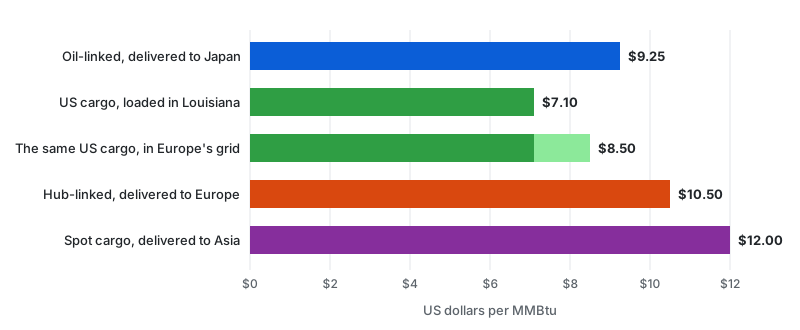
What matters more than the level is what moves each price:
| If this happens | Oil-linked | Henry Hub-linked | Hub-linked | Spot |
|---|---|---|---|---|
| Brent rises $10 | +$1.25 | no change | no change | no change |
| Henry Hub rises $1 | no change | +$1.15 | no change | no change |
| TTF rises $1 | no change | no change | +$1.00 | no change |
| A cold snap lifts JKM $2 | no change | no change | no change | +$2.00 |
A buyer with an oil-linked contract is exposed to the oil market, not the gas market. A buyer of US LNG is exposed to American weather and American drilling. In practice the gas prices pull on each other, because a ship can turn towards whichever market pays more. But each contract follows only the index written in it. A company that buys on one index and sells on another carries the difference, and has to measure it and hedge it.
LNG transport costs: who pays, and how much
Whether transport is inside the price depends on where the cargo changes hands.
| Term | Where the buyer takes the cargo | Who pays for the ship |
|---|---|---|
| FOB, free on board | At the loading port | The buyer |
| DES, delivered ex-ship | At the unloading port | The seller |
Cargo two was sold FOB. Cargoes one, three and four were sold DES, so their prices already include the voyage. To compare them fairly, the US cargo has to be brought home.
Three costs sit between gas in the ground and gas in another country's pipes:
- Liquefaction. Cooling the gas to -162°C. This is the $2.50 fee already inside cargo two's price.
- Shipping. The daily hire of the ship for the round trip, its fuel, the gas that boils off on the way, and port and canal fees. In this example it is roughly $1 per MMBtu, which is what an Atlantic crossing costs when the ship is hired at $120,000 a day. It is the part that swings most.
- Regasification. Unloading the LNG and warming it back into gas, roughly $0.40 per MMBtu in this example.
So the US cargo costs $7.10 + $1.00 + $0.40 = $8.50 per MMBtu inside Europe's network, where gas is worth $11.00. The $2.50 difference is the buyer's margin, and it is why American LNG crosses the Atlantic.
The global gas market article works the shipping sum through step by step, with real charter rates, and turns it round into the netback calculation that decides whether a cargo goes to Europe or Asia.
More than a price
A long-term LNG contract runs for ten to twenty years, and its other clauses can be worth as much as the formula.
- Take-or-pay. The buyer commits to pay for most of the yearly volume whether it takes the gas or not. This is what lets the seller borrow the billions an export plant costs.
- Destination. Some contracts fix the port the cargo must go to. Others let the buyer send it anywhere, and that freedom has a value: the cargo can follow the best price.
- Price review. Many contracts let either side reopen the formula every few years if the market has moved away from it.
Per MMBtu, per tonne, per cubic metre
LNG is priced by energy but shipped by volume and counted by weight, so the same cargo is described in three ways. These are the International Gas Union's standard factors:
| One | Equals |
|---|---|
| Tonne of LNG | 53.38 MMBtu, or 2.222 cubic metres of LNG |
| Cubic metre of LNG | 24.02 MMBtu |
| MMBtu | 10 therms, or 0.2931 MWh |
Cargo one's $9.25 per MMBtu is therefore:
- 9.25 x 53.38 = $494 per tonne of LNG;
- 9.25 x 24.02 = $222 per cubic metre of LNG;
- 9.25 / 0.2931 = $31.56 per MWh;
- 9.25 / 10 = $0.925 per therm.
These factors are averages. LNG from different plants holds slightly different amounts of energy per tonne, and other published tables use lower figures. A real invoice is based on the energy measured when the cargo is unloaded, not on a table.
Is there a UK LNG price?
Not a separate one. Britain has three LNG import terminals: the Isle of Grain in Kent, and South Hook and Dragon at Milford Haven. Once a cargo is warmed back into gas and enters the national network, it is the same as any other gas, and it sells at the British hub price, the NBP.
So the price of LNG in the UK is the NBP price, less what it costs to get through the terminal. A cargo will come to Britain when that beats what it would earn elsewhere.
The NBP is quoted in pence per therm, so comparing it with a cargo price takes two steps. Say NBP is 80p a therm and a pound buys $1.30:
80p a therm = £8.00 per MMBtu = 8.00 x 1.30 = $10.40 per MMBtu
Those two figures are made up as well.
What a desk's systems have to do
An LNG cargo is one of the harder trades for a desk's software to hold, because its price is rarely known when the deal is done.
- The price is a formula. The system has to store the formula, fetch each index it names, and average it over the right months, including months that have not happened yet.
- Units never match. Oil comes in dollars a barrel, TTF in euros per MWh, NBP in pence per therm and the cargo in dollars per MMBtu. Every valuation crosses several conversions and at least one exchange rate.
- The volume is not final. The energy delivered is measured at unloading, after some has boiled off. The first invoice is provisional and is corrected later.
- One cargo, many exposures. A cargo bought on Henry Hub and sold on TTF is short one index and long another, with freight and currency besides. The position report has to show each of them.
Position aggregation and delta exposure shows how a desk adds such exposures up, and what is an ETRM system? covers the system of record that holds them.
Building or replacing this on your own desk? It is the work A115 does. See the systems work
What the full guide adds
This article is the short version of one part of the full guide, Ships and Storage: The Global Gas Market. The guide goes to the depth a desk works at:
- gas supply contracts in full: yearly and daily quantities, nomination ranges, and take-or-pay with a year-end example worked through;
- make-up and carry-forward, and how a buyer with several contracts chooses which to draw on each day;
- gas quality, and how a cargo's measured heating value changes what is paid for it;
- the shipping cost and the netback, to Europe and to Asia;
- price risk while the cargo is at sea, and what a trader can still do about it;
- gas storage and the seasonal trade, with a calculator in Python.
The full guide is in the community on Skool, with the rest of the series, and it is updated regularly as the markets change. If you want to work on a trading desk, read it to understand the subject properly. To join, start at the Energy Trading Fundamentals course page.
Sources
- International Gas Union, Wholesale Gas Price Survey, 2025 edition, for how LNG imports are priced; World LNG Report, 2025 edition, table 9.1, for the conversion factors, including the energy in a barrel of oil.
- Ofgem, consultation on proposed modifications to National Gas Transmission's licence, 22 October 2026, for Britain's three LNG import terminals.
- GIIGNL, annual report 2026, for LNG imports in 2025 and the spot share.
- Cheniere Energy, annual report on Form 10-K for 2025, for the Henry Hub formula and the fixed fee.
- S&P Global, Platts JKM, for what the Japan Korea Marker assesses.
- ACER, LNG price assessment, for the European assessment and benchmark.
- CME Group, Japan Crude Cocktail, for the definition of JCC.