Power trading is the buying and selling of electricity for delivery at a set time, or of financial contracts tied to its price. In Great Britain, companies buy and sell ahead of delivery in auctions and on continuous markets, then adjust as their forecasts change. The National Energy System Operator (NESO) keeps the physical grid in balance, and Elexon works out afterwards what each company owes for the difference between what it contracted and what it actually used or produced.
This article follows one half-hour of electricity through that whole process, with one set of numbers. It is written for engineers, analysts and anyone joining a power desk for the first time. It covers the short-term market, where power changes hands in the last day and a half before delivery. For how those trades differ from swaps and futures, see physical and financial energy trading.
Why power is traded in stages
Electricity has to be produced in the instant it is used. The grid holds very little of it, so supply and demand must match second by second. The physical foundations guide explains why.
Nobody knows tomorrow's demand or tomorrow's wind exactly. A forecast made the day before is good. A forecast made three hours before is better. A forecast made at the last minute is nearly right. The market is built in stages to match: each stage lets companies trade on the best information they have at that point, and the last stage settles whatever is left.
Our example is a small electricity supplier. Its customers will use power between 18:00 and 18:30 on a Wednesday evening, and the supplier has to buy that power for them. On Tuesday morning its forecast for that half-hour is 100 MW of demand.
A megawatt (MW) is a rate. A megawatt-hour (MWh) is an amount of energy. 100 MW for half an hour is 50 MWh, and that is what the supplier needs to buy.
The five stages at a glance
Beginners often mix these up, because three of them are markets and two are not.
| Stage | What it is for | How the price is set |
|---|---|---|
| Day-ahead auction | Setting up tomorrow's position | One clearing price per delivery period, paid by every buyer to every seller in that auction |
| Intraday continuous trading | Adjusting as forecasts change | Each trade has its own price, agreed when a buy order meets a sell order |
| Intraday auction | Adjusting in one scheduled round | One clearing price per delivery period |
| Balancing Mechanism | NESO matching supply and demand in real time | NESO accepts individual offers and bids, each at its own price |
| Imbalance settlement | Charging each company for the gap between contract and reality | One System Price per half-hour, applied to each company's imbalance |
The day-ahead auction
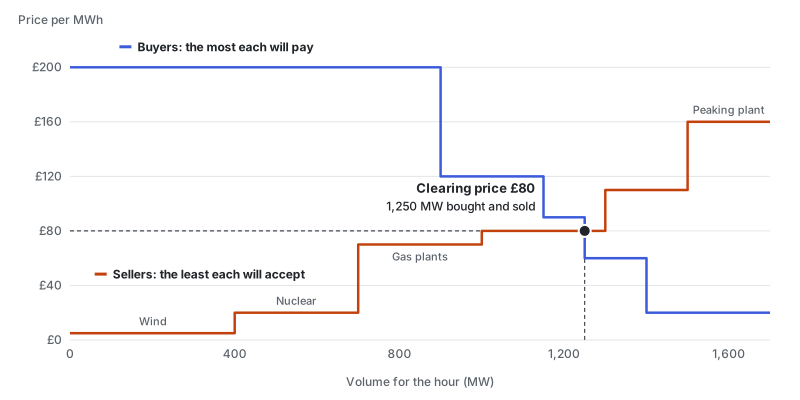
The day-ahead auction is where most of tomorrow's power is first bought and sold. Each auction runs once a day. Buyers say how much they want and the most they will pay. Sellers say how much they can deliver and the least they will accept. Nobody trades until the auction closes.
The exchange then finds, for each delivery period, the price at which the volume offered meets the volume wanted. That is the clearing price. Every accepted buyer pays it and every accepted seller receives it, whatever they bid. A wind farm that offered at £5 and a gas plant that offered at £70 are both paid the same £80, if £80 is where the auction clears.
Great Britain has two power exchanges, EPEX SPOT and Nord Pool, and each runs its own day-ahead auctions. They clear separately, so their prices are usually close but not identical.
| Auction | Orders close (day before delivery, as published) | Products |
|---|---|---|
| EPEX SPOT GB day-ahead | 09:20 GMT | Hourly |
| Nord Pool GB (N2EX) day-ahead | 09:50 UK time | Hourly |
| EPEX SPOT GB half-hour day-ahead | 15:30 GMT | Half-hourly |
Times as each exchange publishes them, checked 11 November 2026: EPEX SPOT gives its times in GMT and Nord Pool in UK time. Nord Pool also runs a half-hourly GB auction; we have left its time out because the published documents we could check do not agree.
The supplier's Tuesday. It bids in the hourly auction for 100 MW across 18:00 to 19:00. The auction clears at £80 per MWh. Half of that hour is our half-hour, so the supplier now holds 50 MWh for 18:00 to 18:30 and owes 50 x £80 = £4,000.
Intraday trading
Tuesday's forecast will be wrong by Wednesday. Intraday trading is how companies correct for that, and it comes in two forms.
Continuous trading works like a stock exchange. Buy and sell orders sit in an order book, and a trade happens the moment a buyer's price meets a seller's. There is no single price: two trades for the same half-hour, minutes apart, can be done at different prices. Trading for a given half-hour runs until shortly before it starts.
Intraday auctions work like the day-ahead auction, at fixed times. Great Britain has two, run jointly with the Irish market: one closes at 17:30 GMT on the day before delivery and one at 08:00 GMT on the day.
The supplier's Wednesday. By the morning the weather has turned colder than expected. The forecast for 18:00 to 18:30 rises to 110 MW, which is 55 MWh. The supplier is 5 MWh short. It buys 5 MWh on the continuous market at £95 per MWh, for 5 x £95 = £475.
The price was higher than the day before, and that is typical when everyone discovers the same cold evening at once. It was still worth paying, for a reason the next two sections explain.
Gate Closure: three deadlines, not one
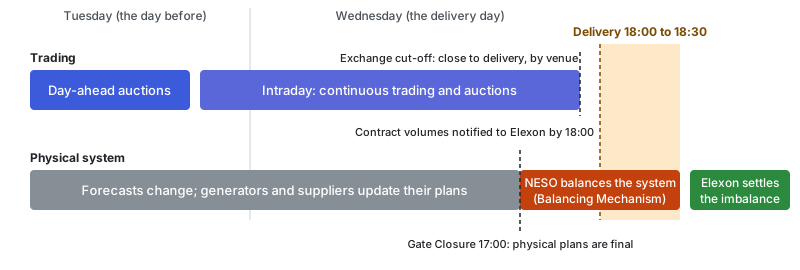
"Gate Closure" is often described as the moment trading stops. It is not, and the difference matters to anyone building the software.
| Deadline | When, for the 18:00 half-hour | What it fixes |
|---|---|---|
| Gate Closure | 17:00, one hour before | Each power station's and large consumer's physical plan, as told to NESO. After this, only NESO can ask for a change |
| Exchange cut-off | Close to delivery; it depends on the exchange and the product | When that product can no longer be traded on that exchange |
| Contract notification | 18:00, the start of the half-hour | The contracted volumes Elexon will use for settlement |
| Settlement | Afterwards | What each company pays or is paid for its imbalance |
Gate Closure and the notification deadline are from Elexon's Balancing and Settlement Code. On Nord Pool, GB half-hour products close 15 minutes before delivery; EPEX SPOT describes its continuous order books as open until delivery starts. Checked 11 November 2026.
So a company can still trade after Gate Closure. What it cannot do is change its physical plan. Between 17:00 and 18:00 the supplier in our example can still buy power on an exchange to cover a late change in its forecast, and that trade still counts in settlement. Its own last deadline is contract notification, at 18:00.
The Balancing Mechanism
From Gate Closure, NESO takes over the physical system for that half-hour. Whatever the market has agreed, supply and demand on the real grid will not match exactly, and some power will be in the wrong place for the network to carry.
NESO fixes this through the Balancing Mechanism. Power stations, batteries and large consumers tell NESO in advance what they would charge to change their output:
- An offer is a price to generate more, or consume less.
- A bid is a price to generate less, or consume more.
NESO accepts the ones it needs, each at its own price, half-hour by half-hour. Our supplier takes no part in this. It owns no power station and NESO asks nothing of it. For a real day of this at full scale, see the day balancing cost Britain £33.6 million.
Imbalance settlement
After delivery, the meters are read. Elexon compares what each company contracted with what it actually produced or used. The gap is its imbalance, and Elexon settles it at the System Price for that half-hour.
The System Price comes from the cost of the actions NESO took to balance the system. Great Britain has used a single price since 5 November 2015: a company that was short pays it, and a company that was long is paid it. The old names, System Buy Price and System Sell Price, survive in the data, but the two are equal in every half-hour.
When the whole system is short, NESO has been buying expensive extra power, and the System Price is high. That is exactly when a short company pays the most.
The supplier's bill. Its customers used 56 MWh, not 55. It had bought 55, so it was 1 MWh short. The System Price for the half-hour came out at £160 per MWh. The supplier pays 1 x £160 = £160.
The whole example
| Stage | Volume | Price per MWh | Cost |
|---|---|---|---|
| Day-ahead auction | 50 MWh | £80 | £4,000 |
| Intraday continuous | 5 MWh | £95 | £475 |
| Imbalance settlement | 1 MWh | £160 | £160 |
| Total | 56 MWh | £82.77 on average | £4,635 |
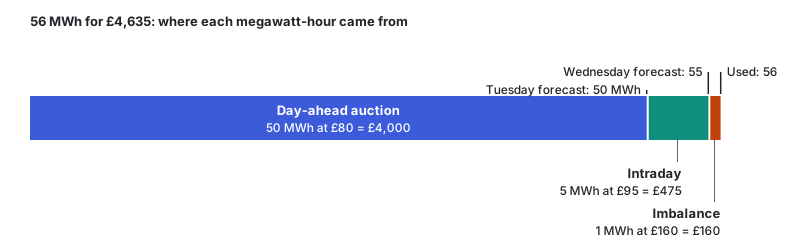
Now the reason for the intraday trade is plain. Had the supplier done nothing on Wednesday morning, it would have been 6 MWh short and paid 6 x £160 = £960 in imbalance. By trading 5 MWh early it paid £635 for the same 6 MWh. Getting the position right before delivery is most of what a short-term power desk does.
These prices are made up for the example; they are not market data. The example is also simplified. A real company settles its whole portfolio together, so its shortfalls and surpluses net off. Real settlement adjusts for transmission losses and is re-run several times as better meter data arrives. And the System Price is not always above the market price: when the system is long, it can be very low, and a short company gets its power cheaply.
What a power desk's systems have to do
Each stage above is a deadline, and there are 48 half-hours in every day. No desk does this by hand. Its software has to:
- take in weather, demand and generation forecasts as they update;
- work out the position for every half-hour: what has been bought, what has been sold, what the latest forecast says is needed;
- build and submit auction orders before each auction closes, and read back the results;
- place and manage orders on the continuous market, and record every fill;
- send physical plans to NESO and contract volumes to Elexon before their deadlines;
- check settlement results against its own records, and find out why when they differ.
Most of the hard problems are about time. Each exchange and each product has its own cut-off. Clock-change days have 46 or 50 half-hours. A system that models "gate closure" as one number will be wrong somewhere.
Jordan Dimov, who wrote this article, built the day-ahead automation on EPEX and Nord Pool for the trading floor at Limejump. What is an ETRM system? covers the system of record these tools sit around.
Building or replacing this on your own desk? It is the work A115 does. See the systems work
Great Britain and the Continent
Most of Europe trades through one coupled day-ahead auction, which sets prices in every country at once and decides the flows across borders at the same time. Since delivery on 1 October 2025 it trades in 15-minute periods. Great Britain left that auction at the end of 2020. Its day-ahead auctions run alone, in hourly and half-hourly products, and capacity on the cables to the Continent is sold separately. Its two intraday auctions with Ireland are a separate arrangement and still run. The UK and the EU are negotiating Britain's return to the European electricity market; nothing had been agreed when this was checked.
What the full guide adds
This article is the short version. The full guide, Auctions, Order Books and Gate Closure, goes to the depth a desk works at:
- an auction cleared by hand, order by order, so you can see where the price comes from;
- block orders, and what happens to a power station that needs to run for several hours or not at all;
- how the order book thins out as delivery approaches, and what that does to the price of waiting;
- a wind farm followed through a full settlement;
- how imbalance prices differ in Germany and elsewhere on the Continent;
- the auction clearing built in Python.
The full guide is in the community on Skool, with the rest of the series, and it is updated regularly as the markets change. If you want to work on a trading desk, read it to understand the subject properly. To join, start at the Energy Trading Fundamentals course page.
Sources
- Elexon, Gate Closure and the trading arrangements (Balancing and Settlement Code); P305, the single imbalance price.
- NESO, What is the Balancing Mechanism?
- EPEX SPOT, trading products; Nord Pool, the N2EX day-ahead auction and GB product specifications.
- SEMOpx, intraday market, for the auctions run with Great Britain.
- NEMO Committee, single day-ahead coupling, for the move to 15-minute periods.