An energy derivative is a contract whose value comes from the price of an energy commodity: gas, power, oil, coal or carbon. Gas and power derivatives come in four main kinds. A forward and a future fix a price for later delivery. A swap fixes a price in cash, with no delivery at all. An option caps a price, or puts a floor under it, for a fee.
This article takes one company and one month, and hedges it four ways with the same numbers. It is written for engineers, analysts and anyone new to a trading desk. It assumes you know roughly how power is bought day to day; if not, start with how power trading works.
Why anyone needs a derivative
Our example is a small electricity supplier. It has promised its customers a fixed price for the winter, and it has to buy the power for them. For January it needs 10 MW around the clock.
January has 744 hours, so 10 MW is 10 x 744 = 7,440 MWh.
It is November. The supplier could do nothing and buy each day's power in the day-ahead auction as January arrives. Nobody knows what those auctions will clear at. Today the market's price for January delivery is £82 per MWh, but a mild January might average £67 and a cold one £97.
| January turns out | Average price | Cost of 7,440 MWh |
|---|---|---|
| Mild | £67 | £498,480 |
| Cold | £97 | £721,680 |
That is a gap of £223,200 on a single month, for a company whose income is already fixed. Removing that gap is called hedging, and derivatives are the tools for it. These prices are made up for the example; they are not market data.
The four contracts at a glance
| Contract | What you agree | Where it trades | What changes hands |
|---|---|---|---|
| Forward | A price now, for delivery later | Directly between two companies, often through a broker | The commodity, at the agreed price |
| Future | The same, in a standard size | On an exchange, through a clearing house | Cash every day as the price moves; the commodity only if you hold the contract into delivery |
| Swap | A fixed price against a published floating price | Between two companies, or cleared | Cash only: the difference between the two prices |
| Option | The right, with no obligation, to buy or sell at a set price | Either | A fee up front; then cash or the commodity, if the right is used |
The first three are called linear: if the price moves £1, the contract's value moves £1 for every MWh in it. An option is not linear, and that makes it harder to value and to manage.
Hedging with a forward
A forward is the simplest contract. The supplier agrees today to buy 10 MW of baseload power for the whole of January at £82 per MWh. Baseload means the same amount in every hour. The seller might be a generator or a trading house.
Come January, the power is delivered and the supplier pays 7,440 x £82 = £610,080, whatever the daily auctions do.
A forward is a private contract between two companies. Each is relying on the other to still be there in January, which is credit risk. Companies manage it with a master agreement that sets the terms for every trade between them, and often with collateral. For how a physical trade is delivered once struck, see physical and financial energy trading.
Hedging with a future
A future is a forward in a standard size, traded on an exchange. The buyer and the seller never face each other. A clearing house stands between them, and it protects itself by collecting margin.
Margin comes in two parts. Initial margin is a deposit paid when the trade is done. Variation margin is paid every day: the contract is revalued at that day's settlement price, and whoever lost money on the day pays it across at once.
The supplier's futures. It buys 10 lots of the January contract at £82. The next day January settles at £79. The supplier's contracts are worth 3 x 7,440 = £22,320 less than it paid, and it must pay that sum to the clearing house in cash. If January later rises to £97, the money flows back, with more besides.
Over the life of the trade the sums come out the same as the forward: the supplier ends up paying £82. The difference is when the cash moves. A hedge that is working perfectly can still demand a great deal of cash on the way.
That is exactly what happened in 2022. Prices rose so far and so fast that sound energy companies struggled to find cash for margin calls on their hedges. The Treasury and the Bank of England opened a £40 billion Energy Markets Financing Scheme in October 2022 to guarantee bank lending to them for that purpose.
Beginners often assume a future always settles in cash. The main British and Dutch contracts do not:
| Contract | Size of one lot | Quoted in | At expiry |
|---|---|---|---|
| ICE UK NBP Natural Gas Futures | 1,000 therms a day, for every day of the delivery period | Pence per therm | Gas is delivered at the NBP |
| ICE Endex Dutch TTF Natural Gas Futures | 1 MW, for every hour of the delivery period | Euros per MWh | Gas is delivered at the TTF |
| ICE UK Base Electricity Futures | 1 MW, for every hour of the delivery period | Pounds per MWh | Power is delivered by notifying the volumes into settlement |
From ICE's contract specifications, checked 12 November 2026.
NBP and TTF are the British and Dutch gas hubs; the global gas market explains them. In practice most futures positions are closed before delivery by making the opposite trade. A company that wants only the price protection sells its futures as the month arrives and buys its power in the daily auctions as usual.
Hedging with a swap
A swap gets to the same place with no delivery at all. Two companies agree a fixed price, a volume and a published floating price. Each month they compare the two prices and one pays the other the difference.
The supplier's swap. It buys a January swap on 7,440 MWh at a fixed £82. The floating price is the average day-ahead auction price for the month. The supplier keeps buying its power in the daily auctions as before.
| January turns out | Power bought in the auctions | Swap settlement | Net cost |
|---|---|---|---|
| Mild, £67 | £498,480 | Supplier pays 15 x 7,440 = £111,600 | £610,080 |
| Cold, £97 | £721,680 | Supplier receives 15 x 7,440 = £111,600 | £610,080 |
Either way the supplier has paid £82. In the mild month the swap cost it money, and that is not a failure. It bought certainty, and it got what it paid for.
The swap only works if the floating price matches what the supplier really pays. If the swap settles against one exchange's index and the supplier buys on another, or its customers use more power in the expensive evening hours than a flat 10 MW, a gap remains. That gap is called basis risk, and a great deal of a desk's work is measuring it.
Because no power is delivered through a swap, anyone can trade one. A fund with no power stations and no customers can take a view on January prices. This is what people mean by the financial side of the market.
Hedging with an option
The forward, the future and the swap all lock the price in both directions. If January is mild, the supplier still pays £82 while a rival that did not hedge pays £67. An option removes that problem, at a cost.
A call option is the right to buy at a set price, the strike. A put option is the right to sell at one. The buyer pays a fee, the premium, and can then walk away if the right turns out to be worth nothing. The seller keeps the premium and takes on the obligation.
The supplier's option. It buys a January call with a strike of £82, settled in cash against the same monthly average. The premium is £5 per MWh, so it pays 7,440 x £5 = £37,200 up front. This is a simplified option, chosen so the sums match the swap's. Exchange-traded options usually work differently, as a later section shows.
| January turns out | Power bought in the auctions | Option pays | Premium | Net cost | Per MWh |
|---|---|---|---|---|---|
| Mild, £67 | £498,480 | Nothing | £37,200 | £535,680 | £72 |
| Cold, £97 | £721,680 | 15 x 7,440 = £111,600 | £37,200 | £647,280 | £87 |
The supplier will never pay more than £87, and it keeps most of the benefit of a mild month. It is insurance, and the premium is the price of the insurance.
The four hedges side by side
| Mild January, £67 | Cold January, £97 | |
|---|---|---|
| No hedge | £498,480 | £721,680 |
| Forward, future or swap at £82 | £610,080 | £610,080 |
| Call option, strike £82, premium £5 | £535,680 | £647,280 |
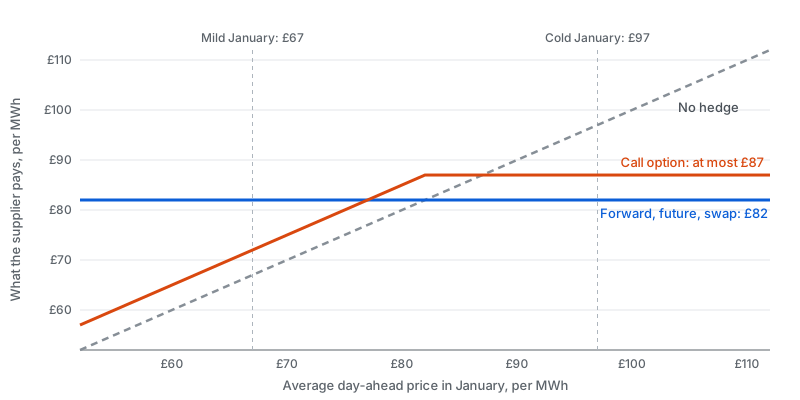
Two break-even points fall out of the sums. The option beats the fixed price if January averages below £77. It beats doing nothing if January averages above £87. Between the two, the supplier would have been better off with either of the others, and has paid for protection it did not use. Which hedge is right depends on what the company can afford to get wrong, and no formula settles that.
What an option is worth
The forward and the swap needed no pricing model: £82 was simply the market's price for January. The option's £5 premium has to come from somewhere.
It depends on five things: the forward price, the strike, the time left, interest rates and volatility, which is how much the price is expected to move about. The standard formula in energy is Black 76, published by Fischer Black in 1976 for options on forward contracts. The more volatile the market and the longer the time left, the more an option costs.
An option's exposure also changes as the market moves. When January trades at £82, the supplier's call behaves roughly like half a forward: it has a delta of about 0.5. If January rises to £100, the call is almost certain to pay out and behaves like a whole forward. Position aggregation and delta exposure shows how a desk adds such positions up.
On the exchange, options usually sit on top of futures. ICE's standard option on TTF gas, for example, can be exercised only at expiry, and it turns into the matching futures contract when it is.
Options hidden in physical assets
Many things in energy are options without being called one.
A gas-fired power station can run when power is worth more than the gas and carbon it burns, and stand idle when it is not. That is a call option on the spark spread, exercised hour by hour. A contract that pays out on that difference is called a spark spread option.
A gas store can inject in summer and withdraw in winter if the price gap is wide enough. A battery does the same thing within a day. Both are options on a difference between two prices, and both are worth more when prices are volatile. A desk that values such an asset as if it will run to a fixed schedule is giving its flexibility away for nothing.
The three things called a CFD
A contract for difference, or CFD, pays the difference between two prices. Mechanically it is a swap. The name is used for three quite different things, and searching for "energy trading CFD" will find all of them.
- A wholesale CFD. Between trading companies, any cash-settled difference contract may be called a CFD, for example one paying the gap between two delivery points or two delivery periods.
- The government's Contracts for Difference. This is how Britain supports new low-carbon power stations. A generator wins a strike price at auction. When the market reference price is below the strike, the Low Carbon Contracts Company pays the generator the difference; when it is above, the generator pays it back. For wind and solar the reference is the hourly day-ahead price. In the latest round, published on 14 January 2026, offshore wind in England and Wales cleared at £65.45 per MWh in 2012 prices, which is £91.20 in 2024 prices.
- A retail CFD. Brokers sell leveraged bets on oil and gas prices to the public under the same name. The Financial Conduct Authority has restricted them since 1 August 2019, with leverage limits and a required warning that states the share of the firm's retail accounts that lose money. This is not what a trading desk means by the word.
What a desk's systems have to do
Each contract in this article is a different object to the desk's software, even when the commodity and the month are the same.
- A forward has to be scheduled, delivered, metered and invoiced on the volume that actually flowed.
- A future has a daily settlement price and a margin call to check against the clearing house's statement.
- A swap needs the published index, every day of the month, and settles on its average. Nothing is delivered, so nothing is scheduled.
- An option needs a volatility as well as a price to be valued. Its position changes when the market moves, even though nobody traded. And when it is exercised it disappears, and a forward or future appears in its place.
A system that books a swap as if it were a physical forward will try to schedule power that does not exist. One that handles exercise in two separate steps will show a profit or a loss, for a moment, that was never there. What is an ETRM system? covers the system of record that has to tell these apart, and mark-to-market P&L covers how the linear ones are valued each day.
Building or replacing this on your own desk? It is the work A115 does. See the systems work
What the full guide adds
This article is the short version. The full guide, Energy Derivatives: Swaps and Options for Energy Markets, goes to the depth a desk works at:
- swap settlement in detail: the index, the averaging period and the payment terms, and how a wrong choice undoes the hedge;
- basis swaps between gas hubs, and crack swaps on refining margins;
- credit risk, netting and clearing;
- Black 76 worked through by hand, then built in Python;
- the Greeks: delta, gamma, vega and theta, with a calculator;
- volatility surfaces, and why one volatility is not enough;
- explaining an options book's daily profit and loss;
- gas storage, swing contracts and batteries valued as options;
- what an ETRM system needs before it can hold options.
The full guide is in the community on Skool, with the rest of the series, and it is updated regularly as the markets change. If you want to work on a trading desk, read it to understand the subject properly. To join, start at the Energy Trading Fundamentals course page.
Sources
- ICE, contract specifications: UK NBP Natural Gas Futures, Dutch TTF Natural Gas Futures, UK Base Electricity Futures and Dutch TTF Natural Gas Options.
- HM Treasury and the Bank of England, Energy Markets Financing Scheme: market notice of 17 October 2022.
- Department for Energy Security and Net Zero, Contracts for Difference Allocation Round 7 results; Low Carbon Contracts Company, Contracts for Difference.
- Financial Conduct Authority, permanent restrictions on the sale of CFDs to retail consumers (2019).
- Fischer Black, "The pricing of commodity contracts", Journal of Financial Economics, 1976.